Why Prediction Markets Are Attracting So Much Attention
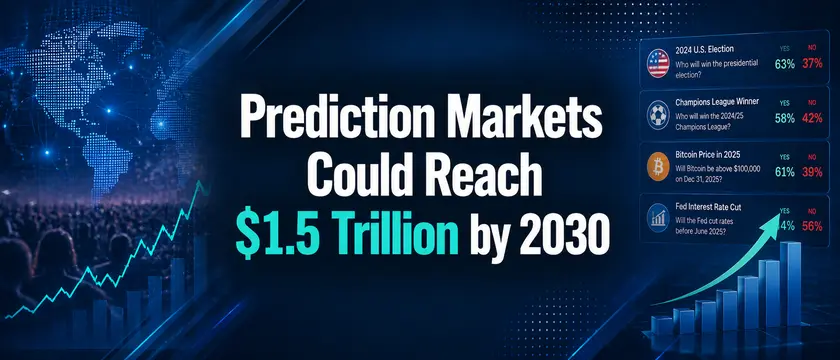
In recent times, prediction markets have become one of the most talked-about areas of the gambling and financial industries. They are not the same as casino games, and they are certainly not the same as online baccarat, but they do appeal to a similar instinct. Instead of betting on cards or a wheel, people are betting on what they think will happen in the real world.
That can mean anything from the result of an election to the outcome of a sporting event, a crypto price movement, or a major economic decision. The basic idea is very simple. If you think something will happen, you buy one side of the contract. If you think it will not, you buy the other.
According to Macquarie analyst Chad Beynon, this type of gambling could become enormous over the next few years. In a recent note to clients, Macquarie estimated that prediction market volume could reach $1.5 trillion by 2030, up from $22 billion last year.
An Important Prediction for the Gambling Industry
The $1.5 trillion forecast is something that the industry is sure to take note of as it suggests that prediction markets could move from being somewhat of a specialist interest to something far more mainstream. Macquarie has predicted that there will be $783 billion of non-sports volume and $705 billion from sports derivatives by 2030.
Beynon explained: “While sports and major events such as the World Cup remain key drivers, non-sports markets are growing faster and expected to become the majority of volume by 2030, supporting the view that prediction markets are becoming a broad event-trading ecosystem.”
This would make the sector far bigger than traditional sports betting. It is thought that politics, cryptocurrency, economic indicators, and business events could all become major areas of interest for prediction markets. In other words, people would not just be making predictions about who wins a game. They would be betting on almost anything that can be turned into a clear yes-or-no question.
How Much Money Operators Could Make
While the volume figure is strikingly large, what really matters to operators is how much revenue they can generate.
According to Beynon, the industry could produce close to $50 billion in annual revenue by 2030 if the $1.5 trillion volume estimate proves accurate. That assumes a net take rate of 3.25% on taker volume.
He explained, “Overall, we believe the prediction market industry could drive 2030E [Estimated] revenue of nearly $50 billion, assuming a net take rate of 3.25% on taker volume.”
This explains why the sector is attracting interest from companies that already operate in gambling, finance, and crypto. Even if the final market ends up being smaller than Macquarie has predicted, it could still be a major source of revenue.
The economics could also be very attractive for the leading platforms. Beynon suggested that an operator with around 30% market share could generate $17 billion in sales and $7 billion in EBITDA by 2030.
Of course, this assumes that the market develops smoothly, which is far from guaranteed. Prediction markets are facing numerous regulatory questions, and the line between financial trading and gambling is not always easy to define.
Why Sportsbooks Are Watching Closely
The growth of prediction markets is especially interesting for sportsbook operators. Companies such as DraftKings and FanDuel have spent years building large customer bases around sports betting, but prediction markets could provide another way to reach more customers.
When Macquarie estimated the prediction market growth, they mentioned several companies that could become important in the sector, including DraftKings, Fanatics, FanDuel, Meta, Polymarket, Robinhood, and Underdog. The report also pointed to FanDuel’s partnerships with CME Group and Crypto.com, as well as DraftKings building its own exchange, as signs that major betting companies are taking prediction markets seriously.
Beynon concluded, “These developments support the view that PM and OSB may ultimately coexist, serving overlapping but distinct customer segments.”
In other words, prediction markets may attract sports bettors, but they are not limited to sports. They may also appeal to people who are more interested in finance, politics, technology, or current events, which means that the potential customer base is far larger.
For gambling operators, this presents both an opportunity and a challenge. They already understand customer acquisition, regulation, risk, and high-volume betting products. However, prediction markets may require a different approach from traditional sportsbook products, and they may find themselves with competition from unexpected directions.